In the Dark About Food? Conspiracy Fills the Gaps—Just Ask Campbell’s
REPRINTED FROM SUBSTACK BY Dr. Sylvain Charlebois

The less consumers understand about how food is made, the more fertile the ground becomes for fear, fiction, and full-blown conspiracy—and Campbell’s is only the latest case in point.
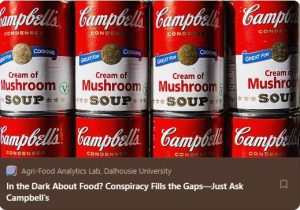
The so-called Campbell’s Soup “scandal” is as surprising as it is awkward. A senior executive—captured in a non-consensual recording—claimed that Campbell’s products are “subpar,” that the company makes “sh*t food for poor people,” and that the chicken in its soups is “bioengineered” and even “3D-printed.” The clip, leaked by a former employee, was meant to expose inappropriate behaviour. It succeeded—but it also unleashed a wave of misinformation and outrage that now lives online permanently, like toothpaste squeezed from the tube.
The claims themselves collapse under the most basic scrutiny. Today, 3D food printing is used almost exclusively in hospitals and long-term care facilities for texture-modified diets, and in a handful of bakeries for decorative purposes. It has no commercial application in producing meat proteins at scale—neither the technology nor the economics exist to “print” chicken for a mass-market soup line. The notion is pure science fiction.
The “bioengineered chicken” allegation fares no better. Genetically modified poultry is not approved for commercial food production in North America. It does not exist in the supply chain. The chicken used by Campbell’s is the same USDA-inspected, conventionally raised chicken used by every major processor. To suggest otherwise reflects a fundamental misunderstanding of both regulation and industrial poultry production.
But in today’s climate, truth is not the dominant currency—emotion is. Conspiracy theories consistently outrun corrections. Boycotts are already emerging across the United States, ironically during one of the most profitable food-purchasing periods of the year: American Thanksgiving. Social media is flooded with memes mocking Campbell’s. The message is unmistakable: in 2025, every food company is permanently on trial, and innocence must be proven after the fact.
Campbell’s has reiterated that its products meet all federal and state standards, and that the executive in question works in IT, far from product development or food safety. But nuance rarely survives in an outrage-driven environment. Optics overshadow expertise. A single employee can drag an entire multinational into a reputational crisis.
Why do these flare-ups take on a life of their own? First, most consumers have limited visibility into how food is produced, processed, and regulated. Social media—Reddit, TikTok, X—fills that knowledge vacuum, often with half-truths or outright fabrications. As with the Loblaw “greedflation” narrative, once a storyline is established online, evidence struggles to catch up.
Second, the industry is grappling with a profound crisis of faith. For decades, food manufacturers have introduced new technologies to improve efficiency and safety. Consumers, however, often struggle to see how these changes benefit them directly. The pandemic deepened this divide, eroding faith in institutions and scientists, and leaving many primed to believe the worst—especially while paying record grocery prices. With record prices comes an elevated demand for accountability, whether justified or not.
This is the new operating environment for the food sector: a world in which every misstatement, every disgruntled employee, and every misleading recording can trigger a national referendum on food integrity. Companies are judged instantly, publicly, and emotionally.
Rebuilding trust will require more than reactive damage control. It demands transparent communication about how food is made, why certain technologies are used, and what regulatory safeguards exist. It requires engaging consumers without condescension and expanding labelling transparency where appropriate. In short, the industry needs to speak before it is spoken for.
Otherwise, the sector will remain dangerously exposed—one ill-informed comment, one leaked clip, or one algorithm-amplified rumour away from the next crisis. In the modern food economy, trust is neither assumed nor stable. It must be earned deliberately, continuously, and visibly.